

Using Experiments and Stories to Inspire the Next Generation of STEM Professionals
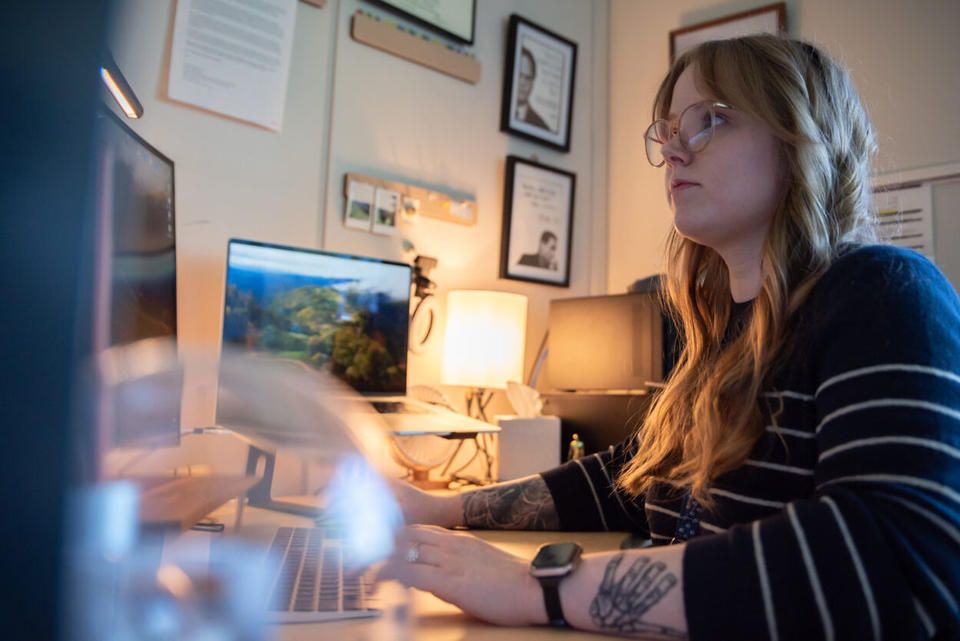
Credit: R. Wilson/NIST
Growing up in rural Pennsylvania, I didn’t have scientists for role models. In fact, I’m the first woman in my family to get a college degree, much less become a scientist.
I attended underfunded public schools, where we didn’t have science, technology, engineering and math (STEM) education beyond the required state minimums.
For the first eight years of my life, I lived with my grandmother, and she instilled in me a love of learning. We read all the time. I brought extra worksheets home from school and worked on them just for fun. My Nanna always told me that I could achieve anything I set my mind to, and today, I’m proud to be a scientist at NIST.
That’s why it’s important to me to connect with young students, so they know that they don’t have to limit their dreams to what they see around them.
My Journey to NIST
That’s not to say my educational and career journey was an easy one; it certainly wasn’t. I worked full-time at a car dealership while attending college part-time. It took me seven years to complete my undergraduate degree.
Today, I’m working in the exciting field of bioinformatics, which uses data to interpret information in biology and medical research. My data expertise helps researchers treat genetic conditions by introducing changes to DNA during its natural repair mechanisms, a process known as genome editing.
We’ve now seen the first patient cured of sickle cell disease from a genome-edited therapeutic. Even more recently, a baby was treated with a personalized genome-editing therapy for a rare metabolic disease known as severe carbamoyl phosphate synthetase 1 (CPS1) deficiency. This cutting-edge science is transforming people’s lives, and I am honored to work alongside so many talented scientists in this revolutionary field.
Inspiring the Next Generation
Just as my Nanna encouraged me to prioritize my education and dream big, I’m trying to help inspire the next generation of scientists. I focus my outreach to students who have similar backgrounds to mine, as these children often don’t have role models who work in STEM-related fields in their daily lives.
I correspond with students through a program called Letters to a Pre-Scientist (LPS). I exchange letters quarterly with a student, and we talk about science and other topics. The teachers and the organization’s coordinator moderate and supervise all communication. The goal is to make connections between students and real-life STEM professionals and inspire children to consider STEM fields as a possible career.
During my first school year in this program, I wrote to an eighth grade student from a STEM-focused magnet school. “Michael” (not his real name) was clearly savvy about science, and he asked me pointed questions throughout the year. He had relatives who worked in STEM fields, so it was easy for him to see me as a normal person who happens to work in science.
For my second school year, I asked LPS to pair me with a student from a lower-income background because I wanted a chance to connect with a child who grew up in similar circumstances to my own.
I was paired with “Elizabeth” (also not her real name), a seventh grader in inner-city Chicago. Elizabeth didn’t have as much exposure to science, so I really had to be intentional in how I explained my work, simplifying the concepts and focusing on relating to her as a person.
Most of her questions were about me, like my pets’ names and what I like to eat. Elizabeth needed to see me as a person before she could grasp the professional side of me and the advice I gave her.
Elizabeth mentioned she wasn’t sure she wanted to pursue a STEM career because she didn’t feel confident in math. I reminded her that math, like any skill, requires practice. I told her I believed in her, and that if she worked at it, I was sure she’d feel more confident in her math classes.
Last school year, I was honored to be one of the pen pals who received an award from the LPS organization for my efforts. Of course, it’s way too soon to know what paths Michael’s and Elizabeth’s careers will take, but I hope I encouraged them on their journey.
Science of Strawberries
Credit: Courtesy of Grove Family Library
One of my favorite ways to encourage a love of science is with hands-on experiments. I’ve guided people through the strawberry DNA experiment everywhere from libraries to farmers markets to elementary schools and Girl Scout troops. I’ve done this experiment many times for audiences ranging from toddlers to high school students and even some adults and senior citizens. Everyone seems to enjoy it. (I certainly do!)
As the name implies, the experiment involves extracting DNA from a strawberry using common household items. All living things, including plants, have DNA. You can perform this experiment with all sorts of vegetables, but the strawberries typically yield a good amount of DNA. It also looks cool because of the red color, and they smell great!
This experiment can help demonstrate lab concepts that may not be as familiar to nonscientists. It also teaches everyone some molecular biology concepts and skills.
One of the things I love the most about these outreach opportunities is how they’ve helped me as a scientist communicate. With each presentation, I have to constantly refine my language to ensure that it’s not too confusing for beginners or too boring for those with more expertise.
As genome editing becomes more common in medical treatment, having the opportunity to talk to members of the general public about this science and my work can help bridge the understanding of a therapy that might become part of their world.
Legal Disclaimer:
EIN Presswire provides this news content "as is" without warranty of any kind. We do not accept any responsibility or liability for the accuracy, content, images, videos, licenses, completeness, legality, or reliability of the information contained in this article. If you have any complaints or copyright issues related to this article, kindly contact the author above.
